Saturday, February 26, 2022

Common Patterns in of Whites

This was one of our handouts in the current Allyship Training this Saturday.  Enlightening exercise.

Directions: review these common group dynamics:

a.     Check-off any dynamics which you have observed or heard about.

b.     Make a note next to the different dynamics that you have personally participated in.

Some/Many Whites Tend to (consciously and unconsciously):

1. believe they have “earned” what they have, rather than acknowledge the extensive unearned advantages they receive; claim that if people of color just worked harder…

2. not notice the daily indignities that people of color experience; deny and rationalize them away with PLEs (perfectly logical explanations)

3. work to maintain the status quo and protect the advantages and privileges they receive

4. believe that white cultural norms, practices and values are superior and better

5. internalize negative stereotypes and believe that whites are smarter and superior to POC

6. want people of color to conform and assimilate to white cultural norms and practices

7. accept and feel safer around people of color who have assimilated and are “closer to white”

8. blame people of color for the barriers and challenges they experience; believe that if they “worked harder” they could “pull themselves up by their bootstraps”

9. believe that people of color are not competent and are only hired/promoted to fill quotas

10. interrupt and talk over people of color

11. resent taking direction from a person of color

12. dismiss and minimize frustrations of people of color and categorize the person raising issues  as militant, angry, having an “attitude,” working their agenda, not a team player...

13. focus on their “good intent” as whites, rather than on the negative impact of their behavior

14. focus on how much progress we have made, rather than on what still needs to change 

15. want people of color to “get over it” and move on quickly

16. get defensive when people of color express frustration with racism

17. “walk on eggshells” and act more distant and formal with people of color

18. live segregated from people of color and rarely develop authentic cross-racial relationships 

19. exaggerate the level of intimacy they have with individual people of color

20. fear that they will be seen and “found out” as a racist, having racial prejudice

21. focus on individualism and refuse to acknowledge cultural and institutional racism 

22. pressure and punish whites who actively work to dismantle racism to conform and collude with white racism; criticize, gossip about, and find fault with white change agents

23. expect people of color to be the “diversity expert” and address racism as their unpaid job

24. minimize, ignore, and discount the competencies and contributions of people of color 

25. rephrase and reword the comments of people of color

26. ask people of color to repeat what they have just said

27. assume the white person is in charge/the leader; assume people of color are in service roles

28. rationalize away racist treatment of people of color as individual incidents or the result of something the person of color did/failed to do

29. dismiss racism when shared by people of color with comments such as: That happens to me too...You’re too sensitive...That happened because of _____, it has nothing to do with race!

30. judge a person of color as over-reacting and too emotional when they are responding to the cumulative impact of multiple recent racist incidents 

31. accuse people of color of “playing the race card” whenever they challenge racism; instead of exploring the probability that racist attitudes and beliefs are operating

32. if racially confronted by a person of color, shut down and focus on what to avoid saying or doing in the future, rather than engaging and learning from the interaction

33. look to people of color for direction, education, coaching on how to act and what not to do

34. compete with other whites to be “the good white:” the best ally, the friend of people of color

35. aggressively confront other white people and distance yourself from your own racist patterns

36. seek approval, validation, and recognition from people of color

37. if confronted by a person of color, view it as an “attack” and focus on HOW they engaged  me, not my original comments or behaviors

38. disengage if feel any anxiety or discomfort; remain silent in discussions of race and racism

39. avoid confronting other whites on their racist attitudes and behaviors

40. when trying to help people of color, feel angry if they don’t enthusiastically appreciate you 

41. believe there is one “right” way or “fit”, meaning “my way” or the “white way”


Monday, January 31, 2022

Feb/March Allyship Training

Registration form for the second part of our training is:  https://forms.gle/w7WNteZr2joDdxHf9.  Registration is due by February 10th.

This training will be facilitated by Kimberly Harris of Distinctive Voice Consulting in Bellingham.  Class size is limited to 20 people, so please keep this in mind.  Those attending will be expected to take the information and lessons they’ve learned back to their congregations and/or groups.

How to be an Ally 2 (2 hours) Introductory level
The purpose of this workshop is to build upon concepts identified in Ally 1 by learning additional concepts and definitions and to continue work around learning about their privilege with the goal of giving participants further confidence to be advocates for equity and inclusion and dismantle oppression and unchecked privilege.

How to be an Ally 3 (2 hours) Intermediate level
Purpose: The purpose of this workshop is to expand upon the concepts learned in How to be an Ally 1 and 2, and continue learning on how to be allies for marginalized and oppressed groups of people.

Beyond Allyship: How Othering Destroys Democracy (2 hours) Intermediate level
Our society has reached a watershed moment with respect to polarization and the global awakening of U.S. systemic racism. U.C. Berkeley Political Science Professor Taeku Lee outlines a framework to identify sources of this polarization and division. The U.C. Berkeley Institute of Othering & Belonging also posits the widespread problem of othering as well as a framework to structural processes and how promoting belonging is the “most important good we distribute in society.” Learn ways to move beyond allyship to explore ways to create welcoming and inclusive environments in hopes to create greater unity and preserve our democracy.  Explore how othering divides our communities and therefore our democracy and how creating a sense of unity and belonging are next steps for allies.

Classes will be held as follows.  Each class builds upon the other, so please don't miss any of them.

      Saturday, February 19, 2022 from 10:30 a.m. – 12:30 p.m., 
      Saturday, February 26, 2022 from 10:30 a.m. – 12:30 p.m., and 
      Saturday, March 05, 2022 from 10:30 a.m. – 12:30 p.m. 

Due to the current state of the Coronavirus 19 variants, it is mutually agreed upon that the workshops will be held online via the Zoom platform. There is no cost as it is covered under existing grants and donations.

Wednesday, October 6, 2021

 Arson destroys Bellingham’s Ukrainian Evangelical Church


Friday Sept 10 about 4:30 in the morning arsonists set fire to the Ukrainian Evangelical Church of Bellingham, 2530 Cornwall.   This is a congregation of about 200 members who had been hoping for 20 years to find a church for their congregants.  They purchased it two years ago and spent those two years with their sweat equity to rehab it. 

The arsonists, yet unknown, knew what they were doing as they opened the gas [most likely from the stoves] and set fires throughout the building and the annex. I understand that the building is now a “tear down,” a loss of hundreds of thousands of dollars. 

NOTE:  At least four members of our congregation (Ann Stevenson, Henry Ohana, Beth Fuller, and Judy Fruhbauer) had been using church space with the Interfaith Coalition’s Conversations and Sandwiches Together.  They made sandwiches and packed supplies that are handed out to the homeless four times a week.  The church was supportive of the work and shared space for the prep work in the kitchen, and for storage, a refrigerator, and shelves in the basement.  BUF Members said it was wonderful to watch the progress of the renovations done by members of the congregation.

Three ways to donate:

  • Through BUF, 1207 Ellsworth, Bellingham, WA 98225 (Check go BUF, memo: “Ukrainian Evangelical Church”) This is tax deductible, and your name will be shared with the church.
  • Check sent to Pastor Alex, addressed : Aleksandr Gamdsey, PO Box 2096, Blaine, WA 98230 

Personal Letters will be Comforting:

Please write personal letters and mail to Pastor Alex, at address above. 

Tuesday, July 27, 2021

Unitarian Indian Boarding Schools and Interfaith Response to boarding school burials

 For those of you who are not aware, literally thousands of bodies of Indian children are being discovered and exhumed from boarding school sites all across the continent.  Yes, Unitarian Universalists also had missionaries running board schools.  Sec. Haaland has ordered review of all US Boarding Schools (https://www.doi.gov/pressreleases/secretary-haaland-announces-federal-indian-boarding-school-initiative) and UUs have been identified (https://boardingschoolhealing.org/healing/for-churches/ ).  The UUA is preparing to receive notice of burials at the site of at least the Bond Mission school.


Several years ago I did some research on UU role in boarding schools and this is what I came up with.  

As of 1902, UU historian Rev. George Willis Cooke’s writings stated there were 3 attempts on the part of Unitarians to undertake “educational work amongst the Indians.”[i]  One mission was among the Chippewa/Objiwa in Minnesota in 1855 that failed due to the lack of funding.  In 1871, President Grant assigned to the Unitarians the responsibility of education the Utes on the reservation near White River, Colorado that was attempted in 1885.  This attempt failed as well due to “not getting sufficient encouragement.”[ii]  In 1886, the American Unitarian Association established a boarding school on the Crow reservation in Montana called the “Montana Industrial School for Indians” or “Bond’s Mission School” run by Unitarian Rev. and Mrs. Henry F. Bond.

J.F.B. Marshall, then Secretary of the Bureau of Southern and Indian Educational Work of the American Unitarian Association, wrote about a Crow girl at the school: calling her “a forlorn, homesick little savage” and “watched with great interest her gradual and progress from barbarism to civilization.”[iii] (Pg 447).  Of all the Crow students, Marshall said “Here are fifty children taken out of the lowest and most degraded forms of savage home-life . . . and they are taught to love neatness, cleanliness and practical Christian life.”[iv]  He went on to say of the students, “instead of being thrust back into a sea of barbarism with no career open to them, and no one to look after them, [they] will enter at once upon a life of usefulness, and like the negro graduates in the South will do credit to their training, and become zealous and successful laborers for the civilization of their race.”[v] 

Rev. Bond himself is recorded as saying this about the Crow students: "They are all bright promising 
boys. How such good appearing fellows come of an ignorant, lazy squalid, orphaned race is a constant 
surprise to us. I shall dread the time, if that comes, when they slip back into their old abodes and 
possibly leave.”[vi]

“The Crow parents wanted to be close to their children, but the Rev. Bond would not allow it in order to maintain discipline and to pursue indoctrination without the outside influences of the family.”[vii]

The school was taken over by the federal government in 1895.

The Mountain Dessert District of the UUA website states “The Mountain Ute Tribe was visited in 1871 by the Rev. Jabez Nelson Trask. The Harvard School graduate was sent by Massachusetts Unitarians to serve as government agent to the tribe at Los Pinos, near Gunnison, Colorado. during that period many Protestant denominations pressured the U.S. government into allotting official posts to missionaries. Extremely confident of his righteousness and comfortably narrow in his view, Trask did not get along with the Utes, though they found him a great source of amusement because of his customary garb: large green goggles and flared trousers. Neglecting to spend any of the monies granted for the benefit of the Ute, Trask was removed from his post after one year. Following Mr. Trask was one General Charles Adams, whom the New England Unitarians were horrified learn was a Roman Catholic. Through political shenanigans the good general, well-liked the Ute, was soon succeeded by the Unitarian, Rev. Henry Bond. Mr. Bond left quickly when a shortage in the cattle fund was uncovered; he resurfaced in Wyoming in the late 1870s.”[viii]


[ii] Ibid., p. 341

[iv] The Unitarian, Volume 5, pg. 390, edited by Jabez Thomas Sunderland, Brooke Herford, Frederick B. Mott http://books.google.com/books?id=b-BAAAAAYAAJ&pg=PA390&lpg=PA390&dq=jfb+marshall+unitarian&source=bl&ots=p45oEY7wZj&sig=JaLMCRVQh8OzmER3eeb3cuE7vRs&hl=en&sa=X&ei=4PtjVNayMNDPiALaxICQBw&ved=0CCYQ6AEwAg#v=onepage&q=jfb%20marshall%20unitarian&f=false

[v] Ibid., pg. 448

[vii] Unintended Consequences:  How the Crow Indians Used Their Education in Ways the Federal Government  Never Intended, 1885-1920, Peter P. Holman

http://www.montana.edu/wwwhi/Papers/PeterHolman.pdf

p9 -10


As a member and UU representative in the Interfaith Network for Indigenous Communities, we were advised by a Native minister that any response however inadequate we felt it might be, would be better than silence.  So, the Network drafted and encouraging its member faith communities to adopt this statement.

A statement from the Interfaith Network for Indigenous Communities regarding Indigenous Boarding Schools, July 2021

While we know that any response to the horrible news of unmarked mass graves at Residential Schools in Canada is inadequate, we also know that our lament must lead to action.  We recognize that, though these atrocities are making headlines and receiving the attention of the world now, tribal communities have been testifying for years to the truth of forced removal, assimilation, abuse, and death perpetrated through boarding schools.  We also know that within the developmental history of the United States, several Christian-based denominations were complicit in the cultural genocide of indigenous people in the United States and that the full story and truth has not yet been told in our country.

Tribal communities have been calling upon complicit Christian-based denominations and state and federal governments to respond to these atrocities for many years.  We also know that the trauma of this history lives on in the lives of people and communities, and all of us are affected.  Telling the truth is a critical step to healing.  So, our first commitment as the Interfaith Network for Indigenous Communities (INIC) is to listen to our indigenous siblings, to hear the truth they have been telling, to do what they have been asking, and to do all we can to advocate for this truth to be heard. 

We call upon our member faith communities here in the Northwest and throughout the country to tell the truth about their own association with Indian Boarding Schools in the United States.  We pledge to advocate and work within each of our judicatories to identify boarding schools sponsored by or in any way associated with our faith communities.  Though in many cases records of these schools have been lost or intentionally destroyed, another sign of the devaluing of indigenous lives, we call upon our various faith bodies to do all they can to conduct research in order to reconstruct this data, make the history of indigenous boarding schools public, and take this important step towards acknowledging accountability.

We pledge to work closely with the National Native American Boarding School Healing Coalition in their efforts to document these truths and advocate for a National Truth and Healing Commission.  We support and pledge to work with Interior Secretary Deb Haaland as she establishes a Federal Indian Boarding School Initiative.  We call upon all our member faith communities to establish their own boarding school truth and healing initiatives to proactively work with, provide information to, and complement the work of Secretary Haaland’s initiative.

INIC also pledges to make available on its website (fanwa.org/INIC) a list of boarding schools by faith community, as an aid in our efforts to advocate and raise awareness and work toward healing.  We also will gather resources for liturgies of lament and make these available as communities continue to do the hard work of telling the truth, moving through pain, trauma, and sorrow toward healing. 

Finally, we know that a radical shift must occur in our own theologies as we seek to repudiate the Doctrine of Discovery and the way Christianity has been used to justify colonialism, domination, slavery, and genocide of indigenous people.  We will make available the growing list of faith communities who wholly reject the premise of the Doctrine of Discovery as we collectively take steps to listen and speak the truth to heal the legacy of boarding schools that are a direct result of this racist theology of domination. 

We pledge ourselves to discovering anew the Spirit that unites us all, in whom we live and move and have our being, and pray for the continual transformation and healing of all. 


Deb Cruz
dwcruz@comcast.net

“Life should not be a journey to the grave with the intention of arriving safely in a pretty and well-preserved body, but rather to skid in broadside in a cloud of smoke, thoroughly used up, totally worn out, and loudly proclaiming “Wow! What a Ride!” ~ Hunter Thompson

“We are talking only to ourselves. We are not talking to the rivers, we are not listening to the wind and stars. We have broken the great conversation. By breaking that conversation we have shattered the universe.” ~ Thomas Berry


_______________________________________________
Social&Environmental Justice Committee mailing list
SocialJusticeCommittee@buf.org
http://buf.org/mailman/listinfo/socialjusticecommittee_buf.org

Saturday, June 26, 2021

Submitted by David Curley.

Professor Spratlen was a resident of Bellingham in the 1960s, and taught in the business school of WWU before being hired by the UW Foster School of Business. While in Bellingham he and his wife Lois Price Spratlen were members of BUF, and very active in children's education and civil rights. They were 'a formidable team' all their lives, and I strongly suspect that they were part of the reason that BUF adopted a strong statement around 1961 in support of Civil Rights. I found this statement in the book about our history in the BUF library.

Here is his UW memorial. I am wondering, can we get a condensed version onto BUF news? I have highlighted the (naturally) short statement about his time at WWU.

Remembering Thaddeus Spratlen: Trailblazing scholar, teacher, mentor and advocate

Thaddeus Spratlen, a professor emeritus of marketing at the University of Washington Foster School of Business, died May 18 at the age of 90.

Spratlen was a genuine giant at the Foster School, a trailblazing Black business educator, a potent and prolific researcher of prescient societal challenges, an innovative textbook author, a mentor and role model for generations of students, a formidable advocate for diversity, equity and inclusion, and the inspiration behind a center that has accelerated the growth of small businesses owned by underrepresented minorities and in underserved communities across Washington and the United States.

“Thad’s tremendous impact on students and faculty is only surpassed by his impact on society,” says Frank Hodge, the Orin and Janet Smith Dean of the Foster School. “His work to help economically challenged communities of color thrive and prosper is exemplary and perfectly embodies the Foster School’s purpose of bettering humanity through business.”

Finding purpose

Thaddeus H. Spratlen was born in 1930 in the tiny town of Union City, Tennessee, and raised in the segregated south during the Great Depression. Despite hard times, his father, a Baptist minister, instilled in him an unwavering passion for excellence.

Showing academic promise from an early age, Spratlen was sent to live with an older brother in Cleveland in the early 1940s. There, he found the educational opportunity that his hometown’s underfunded all-Black school could not provide. But with college tuition looking too expensive after his father died, Spratlen enlisted in the Army in 1948 and earned his officer’s commission in 1952. He served a year of combat duty in Korea, calling in artillery strikes from dangerous forward positions.

“People seeing me 20 years later—by then wearing dashikis and into the culture of the late ’60s, early ’70s—would have hardly believed that I was once a military officer doing this kind of work,” Spratlen said in a 2006 interview. “It’s so out of character with what I’ve become associated with in my later years.”
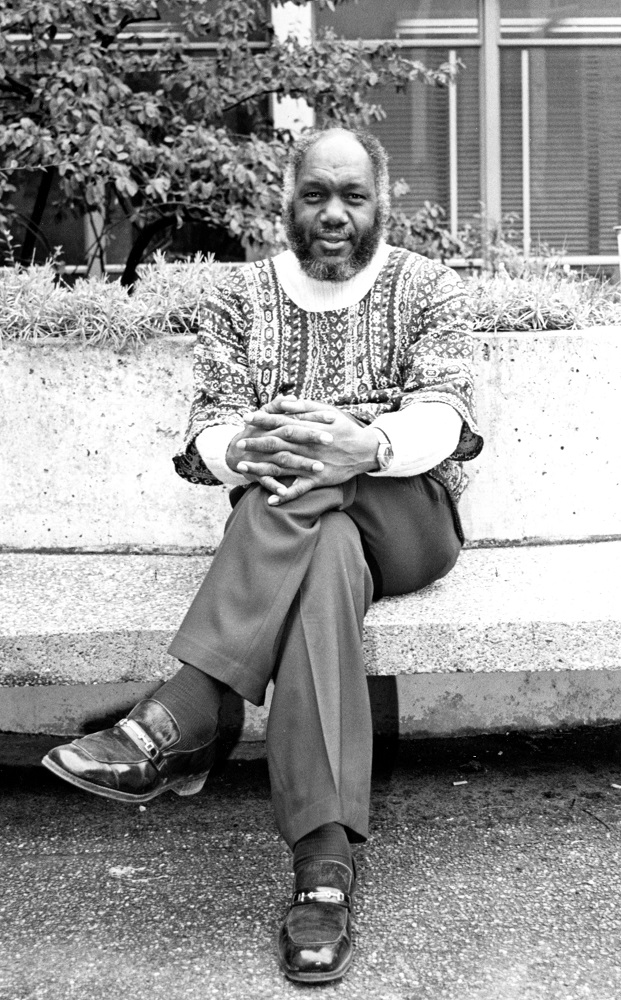
Dr. Spratlen, back in the day.

His transformation may have begun the day he returned to civilian life. After serving in a racially integrated Army, Spratlen returned to a country still widely segregated. But he was not about to let that stand in his way.

Breakthrough academic

Upon marrying Lois Price, the love of his life and a formidable partner, Spratlen continued his studies on the G.I. Bill, earning BA, MA and PhD degrees in quick succession from Ohio State University.

In the early 1960s, the job market for an African American with a doctorate was generally limited to Historically Black Colleges and Universities. But, applying with a CV sans photograph, Spratlen earned his spot as the second Black faculty member at Western Washington University—the first in its department of business and economics.

“Very early on, I had a desire to work on, study and teach issues surrounding race and ethnicity,” he said in 2006. “I always taught mainstream business courses. But I was always moving toward a time when I could focus on social and economic issues dealing with race.”

after eight years at Western Washington (1961-1969) and three at UCLA (1969-1972), Spratlen joined the University of Washington in 1972—the first Black professor at the Foster School, a hire advocated for by members of the school’s newly formed Graduate Association of Black Business Students (which soon expanded into the Association of Black Business Students or ABABS). Spratlen quickly distinguished himself as a significant figure around campus. He proudly became the first faculty advisor to ABBS (which celebrated its 50th anniversary last year).

And he got straight to work. He became the first Black faculty member at Foster to earn tenure. And, over the next five decades there, Spratlen published 75 research papers, books, chapters and documents that both explored mainstream topics of retail management and strategy and probed more pressing urban, racial, ethnic and social issues around marketing and related business disciplines.

Sparking a center

Spratlen’s research in the area of urban enterprise development grew into an innovative course, developed with colleague David Gautschi, that deployed student consulting teams to help grow minority-owned businesses in Seattle’s urban core.

The class—Urban Crisis and the Contemporary Marketing Challenge—inspired a student named Michael Verchot (MBA 1995) to join Spratlen and Dean William Bradford in co-founding the Consulting and Business Development Center in 1995 (then known as the Business and Economic Development Program or BEDP). For many years, Spratlen served as faculty director of and advisor to the center built on his blueprint. He even wrote the essential textbook to share the wisdom of his work: Business Consulting in a Multicultural America (with Verchot et al).
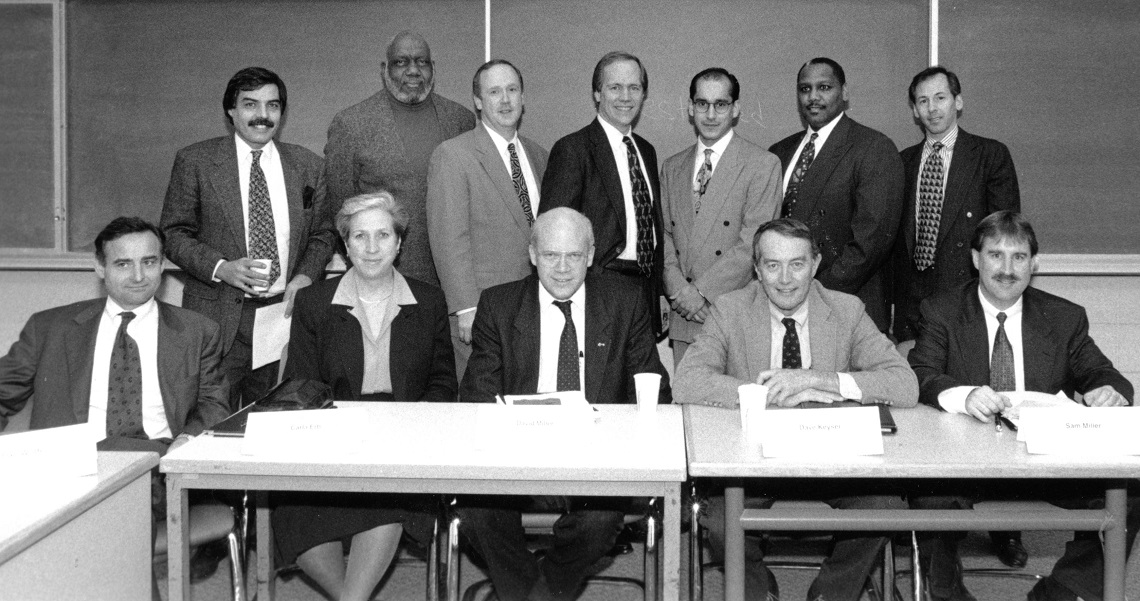
Spratlen (back row, second from left) served on the advisory board of the Consulting and Business Development Center from its founding.

“Thad’s greatest contribution was normalizing and promoting the pedagogical approach that public business schools need to be engaged with the community,” says Verchot, who continues to lead the center in its 26th year. “The center is the embodiment of who Thad is. For 26 years, every major decision about this center was done in consultation with him.”

With Spratlen’s sage counsel, the Consulting and Business Development Center has grown almost exponentially over the past 25 years. Through student consulting and faculty-led management education programs, the CBDC has dramatically accelerated the growth of small businesses owned and operated by people of color, women, LGBTQ+ and those located in underserved communities across the state of Washington. How dramatically? Center-supported businesses have generated more than $250 million in new revenue—at an annual growth rate more than double the state average—and created or retained more than 225,000 jobs since its founding.

In 2016, the center extended its growth acceleration efforts to cities across the United States through its Ascend network, which grows businesses owned by people of color through its proven model: addressing systemic lack of access to management education, money (loans and investment) and markets (to reach new customers and enterprise clients). Ascend is a partnership with JPMorgan Chase, which has invested $13 million in the initiative, including a recent commitment of $8 million to help grow 500 small businesses owned by people of color into multi-million-dollar firms.
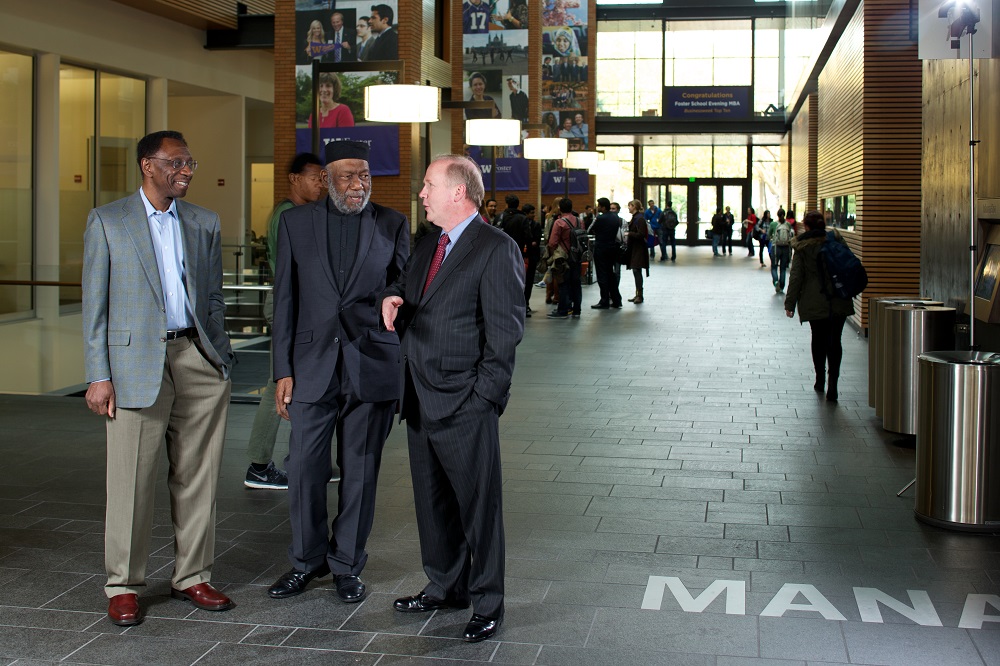
Consulting and Business Development Center founders Bill Bradford, Thad Spratlen and Michael Verchot.

Spratlen’s wisdom was an asset to the very end.

“I spoke with Thad last just ten days ago,” adds Verchot. “And the conversation was about where we’re going next and what more can we do to build a just world. I take that as my charge going forward.”

Lives of service

The spark of a humble inspiration that grew into a nationwide movement, Spratlen remained an essential presence at the center and the Foster School across the decades.

In truth, the Spratlens—collectively—were an essential presence. After they married, Lois Price Spratlen, with a master’s degree in mental health nursing, earned her PhD in urban planning. She leveraged her degree and nursing experience to tackle community issues of equity in public health. Eventually she became a professor of psychosocial and community health nursing at the UW. She was also the first woman, first professional nurse and first African American to serve as UW ombudsman and was inducted into the Washington State Nurses Association Hall of Fame in 2006 before her passing in 2013.
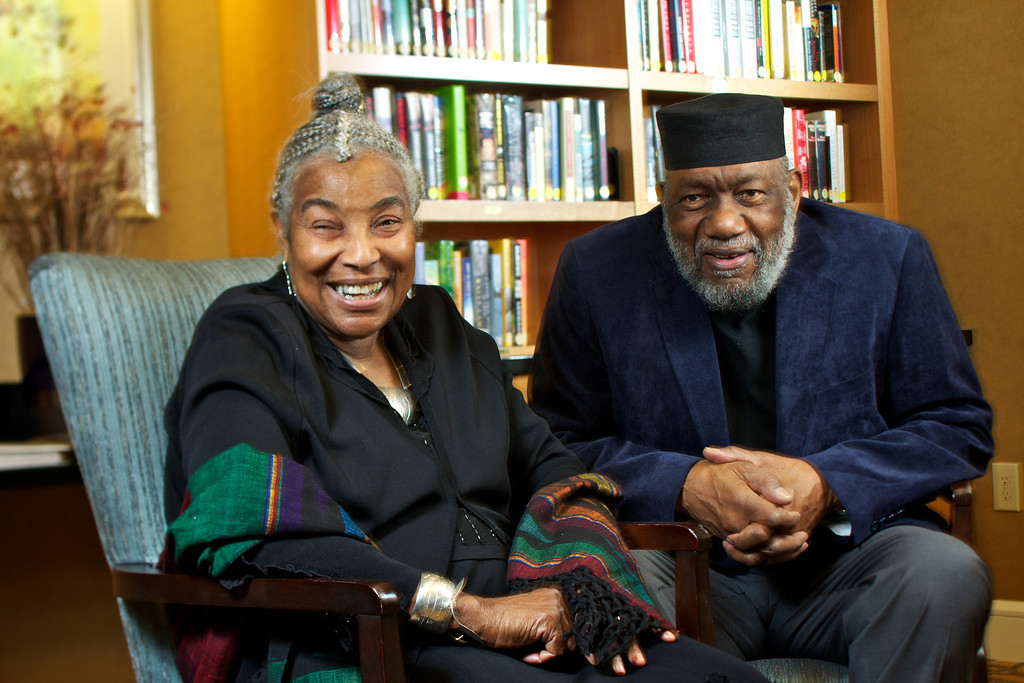
UW Laureates Lois Price Spratlen and Thad Spratlen in 2012.

Meanwhile, Thad served as associate and acting director of Afro-American Studies (1980-1982) at the UW and as legislative representative to the Faculty Senate (1992-1993). At Foster, in addition to his long commitments to the CBDC and ABBS, he received the Dean’s Citizenship Award (2004) and two Andrew V. Smith Faculty Development Awards (1993, 1999).

The Foster School will further honor Spratlen inside Founders Hall, the privately funded $75 million state-of-the-art facility scheduled to open in spring of 2022. Situated prominently among the classrooms, team rooms, centers, career services and event spaces will be a special community gathering space to be called the Spratlen Lounge for Inclusion and Diversity.

“Thad’s legacy will live on each and every day at the Foster School through the Spratlen Lounge for Inclusion and Diversity, which will honor his career and contributions for generations to come,” says Dean Hodge.
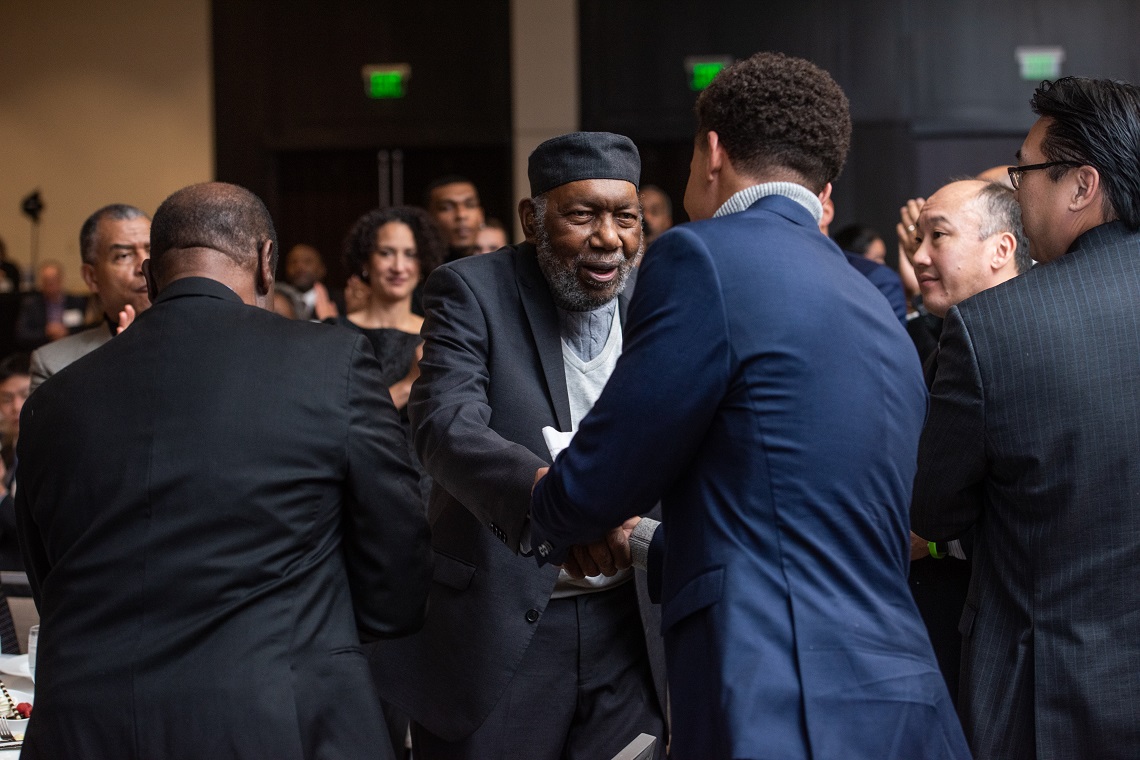
Spratlen takes a bow at the UW Impact Awards.

Beyond the UW, Spratlen served as vice president of the ACLU of Washington and board president of the Jacob Lawrence Catalogue Raisonne Project. He co-founded the Caucus of Black Economists (which became the National Economic Association) in 1975. He received the Frederick Douglass Scholar Award from the National Council of Black Studies. And, for championing efforts of The PhD Project to increase representation of minority faculty across the business disciplines, Spratlen was awarded by the organization for lifetime achievement in 1997 and enshrined in The PhD Project Hall of Fame in 2018.

Even better together

Despite their remarkable solo achievements, the secret power of the Spratlens was their unbreakable bond, their lifelong partnership. It multiplied and amplified their individual powers of the positive. Together, they created the Lois Price Spratlen Foundation to support the development of nursing leaders. And they gave more than $1 million to the UW and Foster School over their lifetimes—much of it endowing a fund that supports student consulting at the Consulting and Business Development Center and ensures its vital work will continue for generations to come.

They’ve also done solid work on their own generations-to-come. The Spratlens’ greatest legacy resides in their five children, whom they raised with the same pursuit of excellence that Thad’s father had preached to him in the depths of the Depression in the segregated south.

Pamela L. Spratlen has served as the US ambassador to Kyrgyzstan and Uzbekistan; Townsand Price-Spratlen is an associate professor of sociology at Ohio State; two-time Olympian Pat Spratlen Etem is a public health community organizer and a mother of three; Paula Spratlen Mitchell is a high school teacher, tennis and volleyball coach and mother of two; Khalfani Mwamba is a clinical social worker, lecturer in the UW School of Social Work and a father of four.

Thad and Lois Spratlen were the UW’s pride and joy.

This point may be apparent to anyone who strolls through the Husky Union Building and notices the striking mural portrait depicting everyday and extraordinary champions of Civil Rights, from Black nurses and students of color to Dr. Martin Luther King, Jr.

At the center of everything—just as they were throughout their remarkable lives—are the Spratlens.

“It is an uplifting experience to receive and share this honor in the name, memory and spirit of Lois Price Spratlen,” said Thad Spratlen at the mural’s unveiling in 2016. “If she were present, you would have heard, ‘This is over the everlasting top!’ I want to thank every one of you who helped us get to the top.”


CSAI 2025 Abolition, Transformation, and Faith Formation

A Congregational Study Action Issue is a collective effort to study an issue over a 3-year period and at the end, develop a Statement of Con...